


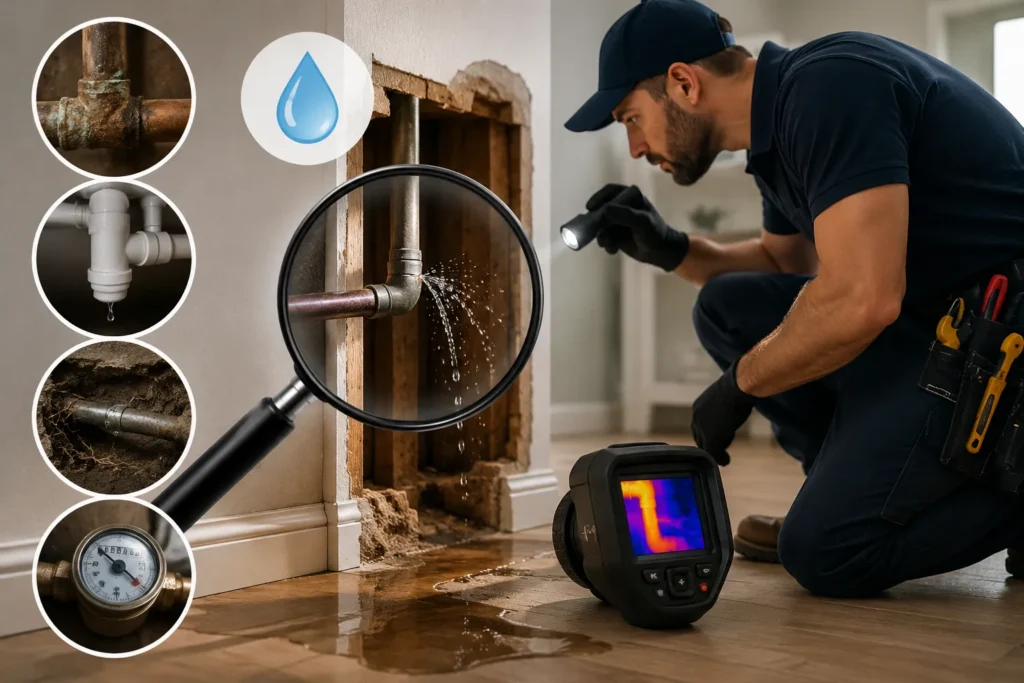
The water bill came in and something was off. Forty dollars higher than last month, with nothing to explain it. No guests, no extra laundry, no change in routine. Then a smell appeared in the hallway. Faint. Damp. The kind of thing you notice once and then keep noticing every time you walk past.
Common hidden plumbing leaks work this way. The water gets into framing and drywall weeks before anything shows at the surface. Whatever pipe or fitting is causing it has been losing water the whole time, and you would not know it from looking at the wall.
Corbin’s Air, Water & Power Solutions has been finding these leaks in Tennessee Valley homes since 1935. This covers the seven causes our plumbers see most often, what each one looks and feels like from inside the house, and how to start tracking one down before the damage gets ahead of you.
What a Hidden Plumbing Leak Is Actually Costing You
Most homeowners picture water damage as a burst pipe or a flooded basement, something dramatic that gets addressed the same day it happens. A slow leak behind a wall is a different kind of problem. It runs for months without showing anything, and by the time it does, the repair costs have already stacked up.
Water damage and freezing ranks as the second most common homeowner insurance claim in the country, sitting just behind wind and hail. The Insurance Information Institute put the average payout on a water damage claim at between $13,954 and $15,400, based on 2023 figures. If mold has taken hold by the time the leak gets found, and it often does, remediation adds another $2,225 on average according to 2026 Angi data.
Standard homeowner policies pay out on sudden, accidental losses. Think of a supply line that fails without warning or a fitting that gives way all at once. A slow seep from a pipe joint that loses water for six months before producing a wall stain reads very differently to an insurer. Most classify that as deferred maintenance and decline the claim. North Alabama’s humidity means mold moves faster here than national averages suggest. Once moisture reaches drywall in an Alabama summer, 24 to 48 hours is enough.
7 Common Causes of Hidden Plumbing Leaks in Tennessee Valley Homes
Every one of these seven causes shares the same basic behavior. They lose water slowly and continuously, long before a stain appears on a ceiling or a floor starts feeling soft underfoot. The leak does not build toward some visible moment. It just runs, day after day, in a space nobody looks at.
Tennessee Valley homes deal with specific factors that make these leaks worse than they would be in drier parts of the country. The humidity here is real. Once moisture reaches drywall or subflooring, mold moves in fast. Often within 24 to 48 hours during an Alabama summer. The clay-rich soils across Marshall and Madison Counties also shift with rainfall and drought cycles, putting stress on underground pipes that most homeowners never consider until something fails.
Pipe material lifespan plays into this too. A home built in Guntersville in 1965 has very different plumbing than one built in 2005. What causes a hidden leak shifts depending on what pipe material sits inside those walls. Each cause below covers the mechanism and where the water goes. Signs sit in the symptoms section that follows.
1. Corroded or Aging Pipes
Galvanized steel was the standard pipe material in most Tennessee Valley homes built before 1980. It does the job for decades, but it corrodes from the inside. Mineral deposits and rust build up along the interior walls, narrowing the passage over years. By the time a pinhole opens and water starts reaching the wall cavity, the pipe has often been degrading for a decade or longer.
Copper pipes fail differently. In areas where water chemistry runs aggressively, with higher chlorine levels or low pH, copper develops pinhole leaks along the barrel of the pipe rather than just at joints. The outside of the pipe looks completely fine. The leak runs regardless. We have found copper pipes in Guntersville homes that were pinholes leaking for over a year before the homeowner noticed anything beyond a slightly higher bill.
PVC and modern PEX rarely corrode. But a joint that sat slightly off during the original installation can hold for years before it starts seeping. Nothing on the surface gives it away.
What pipe material runs through your walls tells you a lot about where a problem is most likely to develop. Our team covers aging supply lines in Tennessee Valley homes in more detail if you want to go deeper on pipe lifespan.
2. Failed Pipe Joint Connections
Every pipe run has joints. Those connection points carry the full water pressure every hour of every day. Hot water running through the line expands the pipe slightly. Cold water contracts it. That cycle repeats thousands of times over the years, and it gradually works a joint loose or cracks the sealant that was holding it together.
When a joint starts failing, water does not rush out. It seeps. A slow drip inside a wall cavity can release enough water over weeks to soak through the drywall backing without ever showing on the painted surface.
Joint failures do not come down to pipe age or material alone. A PEX fitting in a newer home can fail just as quietly as a galvanized elbow in a 1970s house. Pressure and movement over time are the real drivers. Signs that joint failures produce are in the symptoms section below.

3. Silent Toilet Leaks
Most people picture a toilet leak as water pooling on the floor around the base. That is the visible kind. The one that does real bill damage is the one nobody sees.
A faulty flapper valve lets water seep continuously from the tank into the bowl. No overflow. No puddle. The toilet loses water, refills to compensate, and loses more. The EPA estimates a leaking toilet can waste up to 200 gallons per day. When we track down an unexplained bill spike and the meter test confirms active loss, nine times out of ten it comes back to the toilet flapper. Run that for a month undetected and the water bill tells you something is wrong long before the bathroom does.
The ghost flush is the clearest indicator. The toilet refills on its own without anyone using it. You hear the tank fill, go quiet, then fill again a few hours later. The water level drops through the faulty flapper and the fill valve keeps compensating.
Testing for it is straightforward. Drop a small amount of food dye into the tank. Do not flush. Wait 15 minutes. Color appearing in the bowl confirms the flapper is not sealing.
Where Hidden Leaks Are Hardest to Find
The first three causes are inside walls. Corroded pipes, failing joints, a leaking toilet flapper — a careful homeowner can at least narrow down the general area by knowing where the pipes run and what fixtures are nearby.
The next four causes are different. They hide in places that get no regular attention. Behind appliances pushed against walls. Beneath concrete slabs. Inside the cabinet under a water heater that nobody opens unless something already looks wrong. A homeowner doing a thorough visual walk of the house would not find these without getting into spots that rarely see any attention.
That physical inaccessibility is what makes this group of hidden water leaks more likely to run longer before detection. The water moves toward subflooring, soil, or a drain pan that absorbs it quietly. Nothing points toward a surface anyone looks at regularly. Finding these requires detection equipment, not a visual walk.
4. Loose Appliance Water Line Connections
The washing machine sits against the wall with two supply hoses running into the connection behind it. Those hoses flex every time the machine runs. The connection point at the wall valve takes constant vibration. Over years, the fitting loosens or the hose develops a small crack near the end where it bends.
Older rubber washing machine hoses are the most common failure point. Rubber degrades with age and heat cycling. A braided steel hose holds up better, but it still fails at the threaded end if it was not seated properly or has been vibrating for years. The leak runs down the back of the machine and into the wall and floor framing without ever pooling on the laundry room floor.
Refrigerator water lines follow the same pattern. Most run as thin plastic or copper tubing into a valve at the back of the appliance. The connection loosens when the fridge moves during cleaning. The drip works under the fridge and into the subfloor before anyone notices.
Dishwasher inlet connections and drain hose fittings fail under the sink. Water moves into the cabinet below, then into the subfloor, without anything appearing on the kitchen floor.
5. High Water Pressure Damaging Fittings
Residential water pressure has a safe range. It runs between 40 and 80 PSI for most homes. Above 80 and the system starts working against itself.
Most homeowners never check the number. The faucets feel strong so the assumption holds that everything is fine. But a home running at 100 PSI or higher puts continuous stress on every fitting, valve, and connection in the system. Joints that would last decades at normal pressure start loosening faster. Supply hose connections at appliances wear out sooner. Pinhole leaks in copper pipe show up earlier than the material’s lifespan would otherwise suggest.
The pipes signal high pressure before a leak appears. A banging or shuddering sound when a faucet shuts off quickly points to excess pressure in the line. Faucet washers and valve seats also wear out faster than normal when the pressure runs high.
A pressure gauge threads onto any outdoor hose bib and gives a reading in about 30 seconds. They run $10 to $15 at a hardware store. If the reading sits above 80 PSI, a pressure regulator on the main line brings it back into range and reduces the stress on every fitting downstream.
6. Slab Leaks
Beneath the concrete foundation of most Tennessee Valley homes, supply and drain pipes have sat in the ground since the slab poured. The concrete above them shifts with the seasons. Alabama’s clay-rich soils expand when wet and contract when dry. That movement stresses the pipe at points where the ground pulls in different directions, slowly and over decades.
Copper pipe under a slab corrodes from the outside in when surrounding soil runs acidic or when it contacts concrete without protective wrapping. A hot water line that develops a leak under the slab releases warm water into the soil below the floor. That water wicks upward through the concrete slowly. The moisture shows up at the surface well after it started, and well away from the actual source.
Pipes under the slab also take the full force of any water pressure problem in the system, which is one reason slab leaks and high-pressure homes often go together. Our team handles professional slab leak detection in the Tennessee Valley. Because the source sits under concrete, locating it before any repair work begins determines exactly what needs to open and what stays untouched.
7. Water Heater Connection Failures
A water heater connects to the plumbing system at two points at minimum. Cold water comes in at the inlet. Hot water leaves at the outlet. Both fittings sit against a metal tank that expands when hot and contracts when cool. That thermal cycling works on the connections over years. A fitting that was tight on installation day can develop a slow seep a decade later without any dramatic failure event.
The pressure relief valve is the connection most homeowners overlook. Every tank water heater has one. Its job is to open and release pressure if the tank runs too hot, then reseat when things normalize. A valve that has opened under high pressure and reseated imperfectly drips continuously down the discharge tube that runs to a floor drain. That tube leads to a spot nobody watches, so the leak runs unnoticed. We have found PRV tubes dripping into floor drains for months while the homeowner assumed the water heater was just old and inefficient.
Sediment buildup at the bottom of the tank forces the heating element to work harder. Higher tank temperatures stress the fittings and the valve over time. Our team covers water heater leak signs on Sand Mountain and handles water heater leak repair in Huntsville across the Tennessee Valley.
The 5 Warning Signs of a Hidden Plumbing Leak
Knowing the seven causes tells you where a leak comes from. This section covers what you actually notice from inside the house before any pipe or fitting reveals itself.
Each sign below maps to the most likely cause from the sections above. One sign on its own can have multiple explanations. Two or three together narrow it down considerably.
A water bill that climbed without any change in usage
This is the most consistent early indicator across all seven causes. Toilet flapper failures, loose appliance hose connections, and slab leaks all show up here first, often weeks before anything visible appears. Pull the last three months of bills. If usage crept upward steadily with no household change, something is losing water.
A musty smell in one specific area
Mold needs moisture and time. A musty smell in a room with no obvious water source points to moisture sitting somewhere nearby, inside a wall, under a floor, or behind an appliance. The localization matters. It tends to concentrate in one corner or along one wall rather than throughout the room, and that concentration often points toward the general area of the source.
A warm or damp spot on the floor
A warm patch on a tiled floor or a section of carpet that stays damp without explanation points strongly toward a slab leak on a hot water line. By the time you feel warmth or moisture at the surface, the water has been wicking upward through the concrete for weeks, sometimes longer.
Soft drywall or faint staining on a wall or ceiling
Drywall that feels slightly soft to the touch, or a faint yellowish stain that appeared without a clear cause, points to water sitting inside the wall cavity. The stain is not the leak location. Water travels along framing before it finds an exit point, so the source often sits above or beside where the damage shows.
The sound of running water with every fixture off
Turn off every faucet, appliance, and fixture in the house. If water is still audible, something in the pressurized system is losing water actively. Slab leaks and failed pipe joints both produce this sound when the loss rate is high enough to hear.
Quick Reference
Symptom | Most Likely Cause | First Thing to Check |
Water bill rose without usage change | Toilet flapper, appliance connection, slab leak | Run the dye test on every toilet first |
Musty smell in one specific area | Pipe joint or corroded pipe nearby | Check under sinks and behind appliances in that area |
Warm or damp spot on floor | Slab leak on a hot water line | Shut off hot water supply and see if warmth fades |
Soft drywall or wall staining | Pipe joint failure or corroded pipe in wall above | Note exact location and check floor above if accessible |
Sound of running water with fixtures off | Pressurized supply line failure | Go to the water meter and watch for movement |
How to Check for a Hidden Plumbing Leak Yourself
These three methods confirm whether a leak is active and point you toward the general area. They do not locate a leak behind a wall, under a slab, or in buried pipe. That level of precision requires acoustic and thermal equipment. But starting here tells you whether you have a real problem before anyone drives out.
The Water Meter Test
Find your water meter near the street at the edge of the property inside a small ground-level box. Turn off every water source in the house. Faucets, appliances, the ice maker, irrigation if you have one. Write down the meter reading exactly as it shows. Wait two hours without using any water. Come back and read it again. A number that moved means water traveled through the system while everything was off. A leak is active somewhere in the line.
The Toilet Dye Test
Drop food coloring into the tank of each toilet. Do not flush. Wait 15 minutes. Color appearing in the bowl confirms the flapper is not sealing and that toilet is leaking into the drain continuously. Run this on every toilet before assuming the problem sits elsewhere.
The Room-by-Room Visual Walk
Work through each room with these specific spots in mind: under every sink at the supply lines and drain connections, around the base of each toilet, behind the washing machine at the hose connections, at the base of the water heater and around the pressure relief valve discharge tube, and along the floor near the dishwasher. Mineral staining, soft cabinet flooring, or a faint moisture smell in any of these spots points toward an active leak nearby.
If your meter moved or the dye test showed color in the bowl and you still cannot find the source, that is when we step in. Corbin’s can usually get to you the same day. Call (256) 530-7477 and tell us what you found.
What Professional Leak Detection Actually Involves
The most common reason homeowners wait before calling is the assumption that finding a hidden leak means opening walls or pulling up floors to search. That assumption makes sense on the surface. If you cannot see it, the only way to find it must be to open things up.
Professional leak detection does not work that way.
Corbin’s technicians use acoustic listening devices and thermal imaging cameras. Acoustic tools amplify the sound of pressurized water escaping through a pipe wall. A trained technician with the right equipment can narrow the location down to within a few inches through drywall or concrete. Thermal imaging cameras detect the temperature difference between wet building materials and dry ones. Water cools the material it saturates. The camera reads that difference through walls, floors, and slabs without touching them.
Those two tools together locate the source before any surface opens. The technician confirms the exact location first. Only then does anything move.

For a slab leak, that means accessing a precise section of pipe rather than chasing moisture across fifteen feet of flooring. For a wall leak, it means a small targeted opening at the confirmed spot rather than removing drywall across a whole room. Our team covers what makes a plumbing contractor worth trusting in detail for Decatur homeowners here.
Once you have your meter reading and photos ready, we are available around the clock. There is no reason to wait through a weekend watching a water bill climb. Schedule your leak inspection here.
Tennessee Valley Homes, Hidden Leaks, and Corbin’s
That water bill or that smell in the hallway that brought you here is worth following up on. The most expensive hidden leaks are never the ones found early. They are the ones that run through a Tennessee Valley summer inside a wall, feeding mold in conditions that accelerate damage faster than a dry climate ever would.
Corbin’s Air, Water & Power Solutions has been finding what sits behind those walls since 1935. Licensed plumbing technicians, acoustic and thermal detection tools, and transparent pricing before any work starts.
For full-service plumbing throughout the Tennessee Valley, and to understand how other home systems age alongside your plumbing, our team also covers what New Hope homeowners need to know about aging home systems. A hidden leak found today is a repair bill. One found in six months is a restoration project, and gradual damage gets no help from homeowner insurance. Call (256) 530-7477 or book your inspection online.