

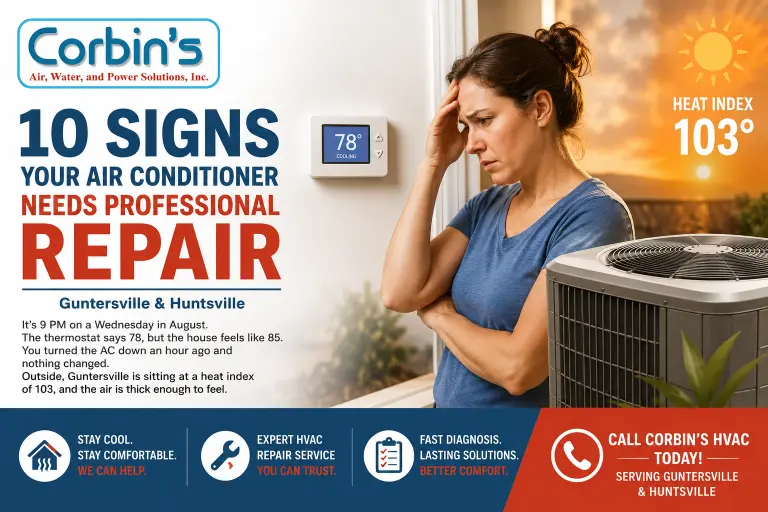
Calling an HVAC company in Decatur when something goes wrong is a particular kind of stressful, because you’re doing it at the worst possible time — in the middle of a July heat wave or a January cold snap — and you’re evaluating a contractor you’ve likely never used before, under time pressure, without the luxury of comparison shopping. The power dynamic in that situation heavily favors the contractor, which is why the HVAC industry has a reputation problem. Some companies exploit the urgency. Some quote parts and labor at rates that bear no relationship to market pricing. Some recommend equipment replacement when a repair would have been sufficient.
Decatur is a large enough market that homeowners have real options — but finding a contractor you can trust before you need them, rather than scrambling to evaluate strangers while your house is 85 degrees, is a much better position to be in. Corbin’s Air, Water & Power Solutions has served Decatur and the Tennessee Valley since 1935, and building that kind of trust relationship is exactly what we aim for with every customer interaction, emergency or otherwise.
Here’s what honest HVAC service looks like in Decatur — and what to watch for when evaluating any HVAC contractor.
What the Decatur Climate Actually Demands From HVAC Systems
Decatur’s Tennessee River valley location creates a climate profile that stresses HVAC equipment in specific ways. Summer humidity from the river and the Wheeler Wildlife Refuge corridor means cooling systems carry a dehumidification load that inland communities at the same temperature don’t face. Summer heat index values above 100 degrees are common through July and August, putting sustained demand on compressors and condensers that may already be operating in degraded condition.
The Old Decatur and Albany district neighborhoods — with their historic homes, many of which retain original single-pane windows and limited attic insulation — have higher-than-average cooling loads per square foot because the thermal envelope is more permeable than modern construction. This means HVAC systems in these homes run more hours per season than comparable systems in newer, better-insulated houses. More hours means more wear, more frequent maintenance needs, and earlier arrival at replacement decision points.
Understanding this context matters for honest HVAC service because a technician who’s aware of it can factor the home’s specific conditions into their diagnosis and recommendations — rather than applying a generic checklist that doesn’t account for the differences between a 1935 Craftsman on Delano Park Boulevard and a 2015 subdivision home on the city’s outskirts.
What Honest HVAC Diagnosis Looks Like
Starting With the Full System, Not Just the Symptom
A technician who arrives for a no-cooling call and goes straight to the outdoor unit without checking the filter, the thermostat, the indoor unit, and the duct system is not running a complete diagnostic. The symptom — no cooling — has multiple possible causes at multiple points in the system, and treating only the most obvious external component without checking the full picture risks missing the actual problem or recommending a repair that’s addressing a secondary issue rather than the root cause.
Corbin’s technicians run a full system check on every service call — indoor unit, outdoor unit, refrigerant pressures, electrical components, filter condition, thermostat operation, and visible ductwork — before making any diagnosis or recommendation. The additional time this takes is the difference between a repair that solves the problem and a repair that doesn’t.
Honest Refrigerant Conversations
Refrigerant diagnosis is one of the areas where trust matters most in HVAC service. A technician who adds refrigerant to a system without first checking for and repairing the leak that caused the low level is doing the homeowner a disservice — the refrigerant will leak out again, and the homeowner will be calling for the same service in another season. Corbin’s approach is to verify the leak, repair it, and then recharge to the correct level — not to treat refrigerant recharge as a recurring maintenance service.
R-22 refrigerant — used in systems manufactured before 2010 — is also now significantly more expensive than it was, due to the federal phase-out of the compound. For Decatur homeowners with older systems that require R-22, an honest conversation about the economics of continued R-22 service versus system replacement is part of what a trustworthy HVAC contractor owes their customer. We have that conversation directly, with the numbers on the table.
Repair vs. Replace — The Honest Framework
Chris Leigh, our senior HVAC technician with over 25 years of experience, is direct about how Corbin’s approaches this conversation: the recommendation should be based on the homeowner’s best financial and practical interest, not on which option generates more revenue for the contractor. A system that’s 8 years old with a specific, repairable component failure gets a repair recommendation. A system that’s 16 years old, has required two repairs in the past three seasons, and is running at significantly degraded efficiency gets an honest replacement conversation that includes the actual numbers — repair cost, estimated remaining system life, projected efficiency improvement from a new system, and the financing options that make replacement accessible.
Homeowners who want to understand this framework more fully should look up the rule of thumb covered in earlier Corbin’s content: multiply system age by the cost of the proposed repair. If the result exceeds \$5,000, replacement is almost always the better financial decision. It’s not a rigid rule, but it frames the decision in a way that a homeowner can evaluate independent of the contractor’s recommendation.
What Preventative Maintenance Actually Prevents
The most effective thing a Decatur homeowner can do for their HVAC system is schedule annual maintenance before each major season — spring for the cooling system, fall for the heating system. This isn’t a platitude. The specific things that maintenance prevents are real and documentable: a failing capacitor caught during a spring visit rather than on a 98-degree afternoon in July, a dirty evaporator coil cleaned before it develops the mold growth that would require professional remediation, a cracked heat exchanger identified before it distributes combustion gases into the living space, a refrigerant level verified and corrected before the system runs a full season under-charged.
Corbin’s CPP (Corbin’s Preventative Partnership) maintenance program is available to Decatur homeowners and commercial customers who want the convenience of scheduled service, priority emergency response, and the confidence that comes from knowing a licensed technician has assessed their system before every demanding season.
The Princess Theatre Problem — Commercial HVAC in Historic Buildings
Decatur’s historic commercial buildings — the Princess Theatre on 2nd Avenue, the historic structures along the downtown corridor, the older institutional buildings that give the city its architectural character — present HVAC challenges that are specific to their construction and use. Original structures weren’t designed with modern HVAC in mind, which means duct routing is constrained, insulation levels are often well below modern standards, and the equipment serving these spaces is frequently a patchwork of additions and replacements that don’t work as a coherent system.
Corbin’s commercial HVAC capabilities include the kind of creative problem-solving that historic commercial buildings require — working within structural constraints that don’t allow conventional duct routes, selecting equipment configurations that meet the building’s loads without dominating the aesthetic, and maintaining systems that may combine equipment of different ages and types. If you manage or occupy a historic Decatur commercial property and your HVAC situation is complicated, we’ve seen complicated before.
Getting on the Right Side of This Relationship
The homeowners and business operators in Decatur who have the best experience with HVAC service are the ones who establish a contractor relationship before an emergency creates the urgency that eliminates their ability to evaluate options carefully. A spring maintenance visit, a system assessment on a piece of equipment approaching end of life, or simply a diagnostic call for a minor issue — any of these creates the opportunity to evaluate Corbin’s work and communication style under non-emergency conditions.
Corbin’s Air, Water & Power Solutions serves Decatur and the full Tennessee Valley with licensed HVAC repair, maintenance, and installation. We’re family-owned, licensed by the State of Alabama Board of Heating, Air Conditioning & Refrigeration Contractors, and backed by a 5-star rating and 139 five-star Google reviews from homeowners and business owners who’ve worked with us in exactly the situations described here. Call 256-582-1000 — same-day appointments available throughout Decatur and Morgan County.