

It’s the middle of a hot summer afternoon. The thermostat says 72°F, but your home feels closer to 85°F. You can hear the air conditioner running, and air is coming out of the vents. The problem is that it’s warm instead of cold.
This situation can be especially frustrating because the system appears to be working. When an AC stops running altogether, the issue is obvious. But when it’s running and blowing warm air, it can be harder to figure out what’s gone wrong.
The good news is that an AC blowing warm air is one of the most common air conditioning problems homeowners face, and the causes are usually easy to narrow down. In some cases, the fix is as simple as replacing a dirty air filter or correcting a thermostat setting. In others, issues such as low refrigerant, electrical problems, or a failing compressor may require professional AC repair.
This guide explains how your air conditioner cools your home, the most common reasons it’s blowing warm air instead of cold, troubleshooting steps you can try yourself, and when it’s time to call a licensed HVAC technician.
Why Is My AC Blowing Warm Air?
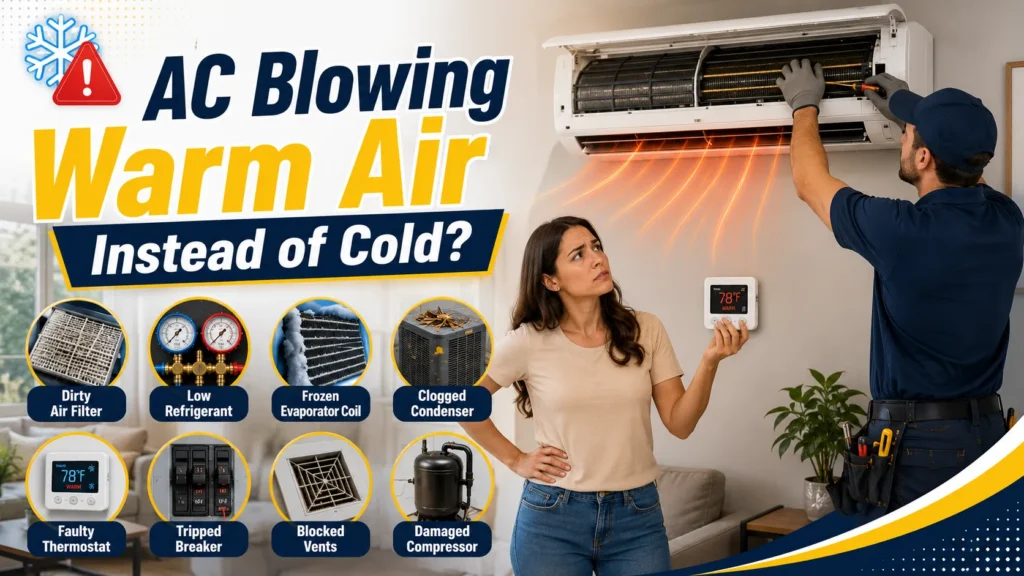
Your AC may be blowing warm air because of incorrect thermostat settings, a dirty air filter, a refrigerant leak, a frozen evaporator coil, dirty condenser coils, a blocked outdoor unit, a tripped breaker, a faulty capacitor, blower motor issues, compressor failure, duct leaks, or electrical problems. Some issues can be fixed by homeowners, while others require an HVAC technician.
How Your Air Conditioner Cools Your Home
Before you can diagnose warm air, it helps to understand what your system is supposed to be doing. Air conditioners don’t create cold. They move heat out of your house and dump it outside. Every cause on the list below is a break somewhere in that transfer.
Indoor Unit
The indoor side sits in your closet, attic, basement, or crawlspace.
- Evaporator coil. Cold refrigerant runs through this coil. Warm air from your home passes over it, heat gets absorbed, and the air leaving the coil is cool.
- Air handler. The cabinet housing the coil, blower, and filter. On a furnace based system, the furnace acts as the air handler in summer.
- Blower fan. Pulls warm air from your rooms through the return, pushes it across the evaporator coil, then sends the cooled air back out through the ductwork.
Outdoor Unit
The outdoor unit is the metal box beside your house.
- Compressor. The heart of the system. It pressurizes refrigerant and keeps it circulating. When the compressor stops, cooling stops.
- Condenser coil. Releases the heat your indoor coil collected. This is why the air blowing off the top of your outdoor unit feels hot.
- Condenser fan. Pulls outside air across the condenser coil to carry that heat away.
Refrigerant Cycle
Refrigerant moves in a closed loop between the two units. It absorbs heat indoors, turns to a low pressure gas, travels outside, gets compressed, releases the heat through the condenser coil, turns back to liquid, and returns indoors through the expansion valve to start again.
Now here’s why this matters for your problem. If refrigerant is low, the loop can’t carry enough heat. If the condenser coil is filthy, the heat has nowhere to go. If the blower fails, no warm air reaches the indoor coil. If the compressor dies, the refrigerant stops moving entirely.
Every one of those failures produces the same symptom at your vents: air that isn’t cold.
12 Reasons Your AC Is Blowing Warm Air
These are ordered roughly from easiest to fix to most involved. Work down the list.
1. Thermostat Is Set Incorrectly
Symptoms: The fan runs continuously, air comes out of the vents, but there’s no cooling at all.
Check:
- Is the system set to Cool, not Heat or Off? Auto changeover thermostats sometimes flip after a program update or a power blip.
- Is the fan set to Auto, not On? This one catches a lot of people. With the fan on ON, the blower runs 24/7 even when the compressor isn’t cooling, so you get room temperature air between cooling cycles and assume the AC failed.
- Is the temperature setting below the current room temperature? A setpoint of 78 in a 76 degree room means the system has no reason to run.
Fix: Adjust the mode and fan settings first. If the display is blank or dim, replace the batteries. Then wait 15 minutes and check the vents again.
This is the cheapest possible outcome, which is exactly why you check it before anything else.
2. Dirty Air Filter Restricting Airflow
Symptoms: Weak airflow from the vents, higher energy bills for the same usage, and cooling that gets worse over weeks rather than failing overnight.
A clogged air filter chokes the airflow across your evaporator coil. Less air over the coil means less heat removed, and eventually the coil gets so cold it ices over, which blocks airflow completely.
Fix: Pull the filter out and hold it up to a light. If you can’t see light through it, replace it. Standard one inch filters need changing every 30 to 90 days. Pleated four or five inch media filters typically run six months to a year.
Maintenance schedule: Homes with pets, smokers, or ongoing renovation work should check monthly. Everyone else, set a calendar reminder for the first of every other month.
If you replaced the filter and the system still blows warm, give it a few hours. A coil that iced up needs time to thaw before cooling returns.
3. Refrigerant Leak or Low Refrigerant
Symptoms: Air conditioner not cooling, a hissing or bubbling sound near the indoor unit or the refrigerant lines, ice buildup on the copper line running to the outdoor unit, and cooling that gets progressively worse through the season.
Here’s something worth understanding: refrigerant is not consumed. It circulates in a sealed loop. If your levels are low, there is a leak. Full stop. Anyone who tops off your system without finding and repairing the leak is selling you a temporary fix that will fail again.
Fix: Professional leak detection using electronic detectors, UV dye, or nitrogen pressure testing. Once located, the leak gets repaired, the system gets evacuated, and refrigerant is recharged to manufacturer spec.
This is not DIY territory. Handling refrigerant requires EPA Section 608 certification, and the sealant cans sold in auto parts stores can contaminate the system and damage the compressor.
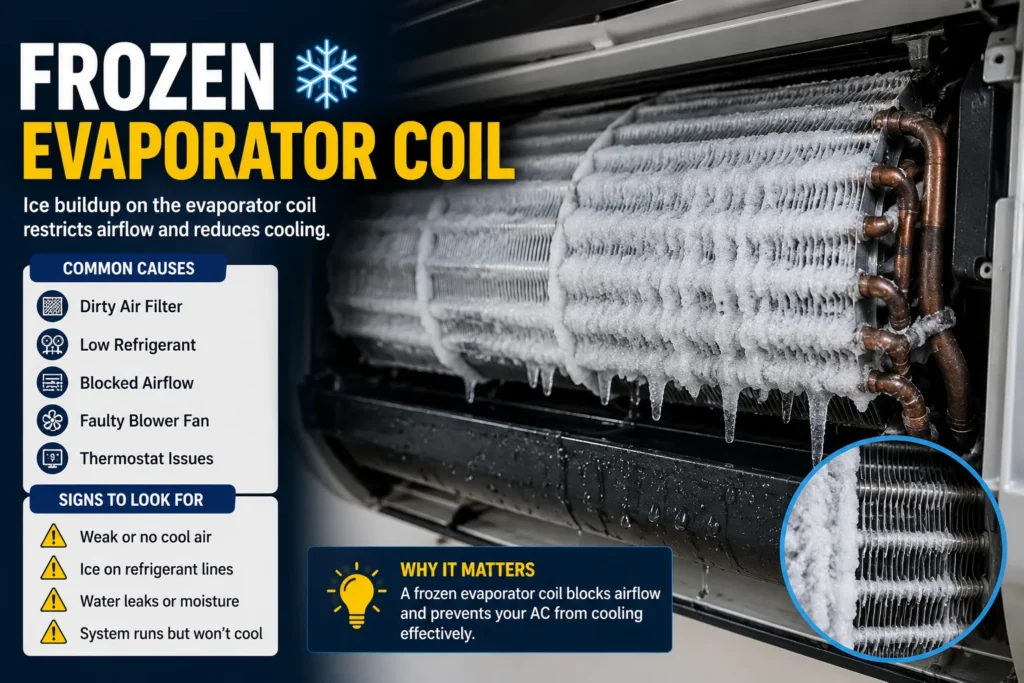
4. Frozen Evaporator Coil
Symptoms: Visible ice on the indoor unit or the refrigerant line, very weak airflow at the vents, and water pooling near the air handler as the ice melts.
Causes: Restricted airflow from a dirty filter or closed vents, low refrigerant, a failing blower motor, or running the system when outdoor temperatures drop below about 60 degrees.
Fix: Turn the system to Off and set the fan to On. Running the blower without the compressor pushes room temperature air across the coil and thaws it faster. Expect anywhere from two to eight hours. Never chip at the ice with a tool, because the coil fins and refrigerant tubing puncture easily.
Once it thaws, replace the filter and restart. Call a technician if it freezes again. A recurring freeze means an underlying fault you haven’t corrected, and repeated freezing causes liquid refrigerant to reach the compressor, which is how a $200 problem turns into a $2,000 one.
5. Dirty Condenser Coils
Symptoms: The outdoor unit runs constantly without satisfying the thermostat, cooling gets noticeably worse in peak heat, and the outdoor unit feels unusually hot.
This is the cause most articles rush past, and it deserves more attention. Your condenser coil is where all the heat from your house gets released. When those fins are packed with dust, cottonwood, grass clippings, and dryer lint, the heat can’t escape. The system keeps running, keeps drawing power, and keeps failing to cool.
Coils in [Service Area] get dirty faster than most homeowners expect, especially units sitting near a driveway, a dryer vent, or a lawn that gets mowed weekly.
Fix: Shut off power at the disconnect box beside the unit. Rinse the coil fins from the inside out with a garden hose at moderate pressure, working top to bottom. Never use a pressure washer, because it bends the fins flat and makes the problem permanent.
Seasonal maintenance: A professional coil cleaning during your annual AC tune-up uses a proper coil cleaner that lifts embedded debris a hose can’t reach. If you only book one maintenance service a year, this is a large part of what you’re paying for.
6. Blocked Outdoor Condenser Unit
Symptoms: Warm air from vents, poor efficiency, longer run times, and a system that keeps up on mild days but falls behind when it gets hot.
Related to dirty coils but distinct. Here the coil may be clean while the unit itself can’t breathe.
Common blockages:
- Leaves piled against the cabinet
- Grass and weeds grown up around the base
- Shrubs planted too close for landscaping reasons
- Fence panels or privacy screens installed tight to the unit
- Stored items leaning against the housing
Fix: Clear 2 to 3 feet on all sides and keep at least 5 feet of open space above the unit. Trim back vegetation. Move anything stacked against it. This takes fifteen minutes and costs nothing.
7. Tripped Circuit Breaker
Symptoms: The indoor fan works and you feel air at the vents, but the outdoor unit is silent. Walk outside and listen. If the outdoor unit isn’t running while the indoor blower is, this is your most likely cause.
Most central air systems use two separate breakers, one for the air handler and one for the condenser. When only the condenser breaker trips, you get exactly this: air moving, no cooling.
Fix: Open the electrical panel and look for a breaker sitting between on and off. Push it fully to off, then firmly back to on. Also check the outdoor disconnect box beside the condenser for a pulled fuse or a switch someone flipped during yard work.
Important: Reset it once. If the breaker trips again, stop. Repeated trips mean a short, a seized compressor, or a failing capacitor drawing excess current. Continuing to reset a tripping breaker is how electrical fires start.
8. Faulty Capacitor
Symptoms: A humming or buzzing sound from the outdoor unit, the condenser fan not spinning or spinning only after you nudge it, clicking sounds, and a system that starts hard or won’t start at all in high heat.
The capacitor stores an electrical charge and delivers the jolt that gets the compressor and fan motors turning. It’s a small cylindrical part, and it’s one of the most common failures on residential air conditioning systems, especially in hot climates where units run long cycles.
Capacitors also give the clearest warning sign of any component on the list. That hum with no fan movement is a capacitor telling you it can’t start the motor.
Fix: Professional replacement. The part itself is inexpensive and the swap takes a technician under an hour, which makes this one of the better outcomes on this list.
Do not attempt this yourself. Capacitors hold a lethal charge even with power disconnected, and they need proper discharging before removal. This is genuinely dangerous, not liability boilerplate.
9. Condensate Drain Line Clog
Symptoms: Water leaking around the indoor unit, a full drain pan, the system shutting down on its own, or a musty smell near the air handler.
Your evaporator coil pulls humidity out of the air, and that condensation drains away through a PVC line. Algae and sludge build up inside that line over time. When it clogs, water backs up into the pan, and the float switch shuts your system down to prevent water damage. Many homeowners see the shutdown and assume a major failure.
Fix: Locate the drain line access cap near the indoor unit. Attach a wet/dry vacuum to the outdoor end of the line and run it for two to three minutes to pull the clog through. Follow up by pouring a cup of distilled vinegar into the access port every few months to keep algae down.
10. Blower Motor Problems
Symptoms: Weak airflow at every vent, uneven cooling from room to room, squealing or grinding from the air handler, or a blower that runs briefly then shuts off.
The blower motor moves conditioned air through your ductwork. When it weakens, air sits too long against the coil, cools too much, and the coil ices over. When it fails completely, no air moves at all.
Fix: Motor repair or replacement, depending on the cause. Sometimes it’s a bad blower capacitor or a failed control board rather than the motor itself, which is a much smaller job. A proper diagnosis matters here, because “replace the blower motor” and “replace the blower capacitor” are very different invoices.
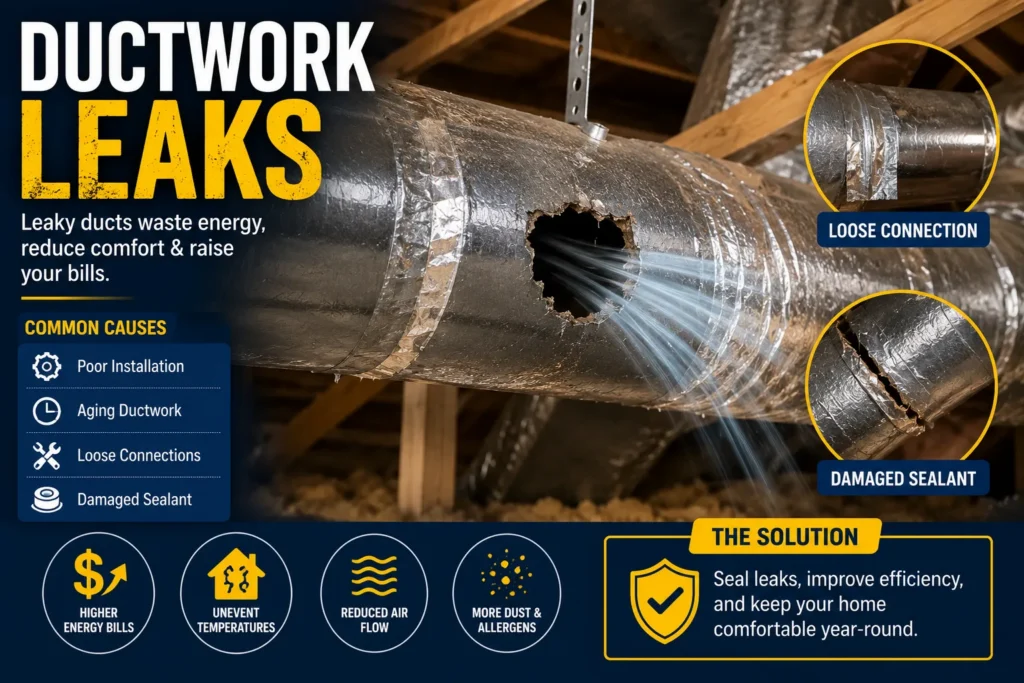
11. Ductwork Leaks
Symptoms: Some rooms cool fine while others stay hot, high utility bills without a change in usage, visible dust around vent registers, and an attic or crawlspace that feels cooler than it should.
Your system may be producing perfectly cold air that never reaches you. Leaking duct joints in an unconditioned attic dump cooled air into a space that hits 130 degrees in July. Return side leaks pull that superheated attic air straight into your system, which is why the air at the vents can feel warm even when the equipment is healthy.
Fix: Duct sealing with mastic or UL 181 rated foil tape at the joints, plus repair of any disconnected sections. On older homes, a professional duct blaster test measures actual leakage before and after so you know what you bought.
Never use standard cloth duct tape. It dries out and falls off within a couple of seasons, which is one of the more ironic facts in this trade.
12. Compressor Failure
Symptoms: No cooling at all, loud grinding or screeching from the outdoor unit, hard starting, breaker trips when the unit tries to start, or an outdoor unit that hums but never engages.
The compressor is the most expensive component in your system. When it fails, you’re at a real decision point rather than a repair.
Fix: Professional diagnosis first. Sometimes what looks like compressor failure turns out to be a capacitor, a contactor, or a wiring fault, and those are minor repairs. A technician will check start amps, capacitor values, and refrigerant pressures before condemning the compressor.
If the compressor truly is dead and the system is past ten years, replacement of the full system usually makes more financial sense than a compressor swap, especially given that older units run refrigerant that’s been phased down and is getting expensive.
AC Blowing Warm Air? Follow This Troubleshooting Checklist
Run these in order before calling anyone. Most homeowners find the problem somewhere in the first four steps.
Step 1: Check thermostat settings. Confirm Cool mode, Auto fan, and a setpoint several degrees below current room temperature. Replace the batteries if the screen is dim.
Step 2: Replace the dirty filter. Pull it, hold it to a light, replace it if it’s loaded. Note the size before you go to the store.
Step 3: Inspect the outdoor unit. Is it running? Is the fan spinning? Clear leaves, grass, and debris. Confirm 2 to 3 feet of clearance on every side.
Step 4: Check the breaker panel. Look for a tripped AC breaker. Reset it once. Also check the outdoor disconnect box.
Step 5: Look for ice buildup. Check the indoor coil and the refrigerant line. If you see ice, shut the system off, set the fan to On, and let it thaw fully.
Step 6: Check airflow at vents. Walk the house. Are all supply registers open? Is airflow weak everywhere, or only in certain rooms? Everywhere points to the filter, blower, or coil. Certain rooms points to ductwork.
Step 7: Call an HVAC professional. If you’ve run steps 1 through 6 and the air is still warm, the fault is inside the sealed or electrical side of the system.
When Should You Call an HVAC Technician?
Skip the checklist and call right away if any of these apply:
- Refrigerant leak suspected. Hissing sounds, ice on the copper lines, or cooling that has faded over weeks. Refrigerant work is legally restricted to certified technicians.
- Frozen coils keep returning. One freeze is a symptom. A second freeze after you replaced the filter means something structural is wrong.
- Burning smells. Any electrical or burning odor from the indoor or outdoor unit. Shut the system down at the breaker first.
- Electrical issues. Repeated breaker trips, scorch marks, buzzing at the disconnect, or a humming outdoor unit that won’t start.
- Compressor failure signs. Grinding, screeching, or an outdoor unit that hums without engaging.
- The system won’t cool at all after you’ve worked through every basic check.
Emergency AC repair costs more than a scheduled visit, but running a system with a known fault often turns a component repair into a full replacement. The math usually favors calling early.
How Much Does It Cost to Fix an AC Blowing Warm Air?
Repair costs vary widely by region, equipment brand, system age, and how accessible your units are. Rather than quoting numbers that won’t match your market, here’s the relative scale so you know what to expect before the technician arrives.
Problem | Typical Repair Cost |
Thermostat | Low |
Air filter | Very low |
Capacitor | Low to medium |
Refrigerant leak | Medium to high |
Coil cleaning | Medium |
Blower motor | Medium to high |
Compressor | High |
Two things worth knowing before you get a quote. First, always ask for the diagnosis in writing with the specific failed part named. Second, on any repair quoted above roughly a third of replacement cost on a system past twelve years, ask for a replacement estimate alongside it so you can compare properly.
For current pricing in [City], [Brand Name] provides written estimates before any work begins. Call [Phone Number] to schedule a diagnostic visit.
How to Prevent Your AC From Blowing Warm Air
Most of the failures above are preventable, and prevention costs a fraction of emergency repair.
Change air filters regularly. Every 30 to 90 days for one inch filters. This single habit prevents frozen coils, protects the blower motor, and keeps efficiency up.
Schedule annual AC maintenance. Book it in spring before the first heat wave. A proper tune-up checks refrigerant charge, cleans coils, tests capacitor values, inspects electrical connections, clears the condensate line, and measures temperature split. Most of the failures on this list get caught here first.
Keep the outdoor unit clean. Rinse the condenser coil each spring and clear debris after storms and yard work.
Inspect refrigerant levels. Not something you do yourself, but a technician checking charge annually catches a slow leak before it starves the system and damages the compressor.
Clear vegetation around the unit. Maintain that 2 to 3 foot perimeter year round. Trim shrubs back in spring and again mid-season.
Address small problems early. Weak airflow, longer run times, a slight rise in bills, or a new noise. These are early warnings. Systems almost always tell you something is wrong months before they quit.
Conclusion
An AC blowing warm air is frustrating, but it’s rarely mysterious. The cause is almost always sitting in the list above, and the cheap fixes cluster at the top.
Start with the thermostat, then the filter, then the outdoor unit, then the breaker. That sequence resolves a large share of these calls with no tools and no service fee. If you get through all seven checklist steps and the air is still warm, the fault is in the refrigerant circuit, the electrical components, or the ductwork, and that’s where a licensed HVAC technician earns their keep.
The bigger takeaway is that most of these failures announce themselves early. Longer run times, weaker airflow, a bill that climbed without a reason. Systems that get an annual tune-up and a fresh filter every couple of months rarely quit in the middle of a heat wave.
If your AC is blowing warm air in [City] or anywhere across [Service Area], [Brand Name] can diagnose it and get your home cooling again. Call [Phone Number] or book online.
What did your system do before it stopped cooling? The warning signs usually show up weeks in advance, and catching them is what separates a filter change from a compressor replacement.