
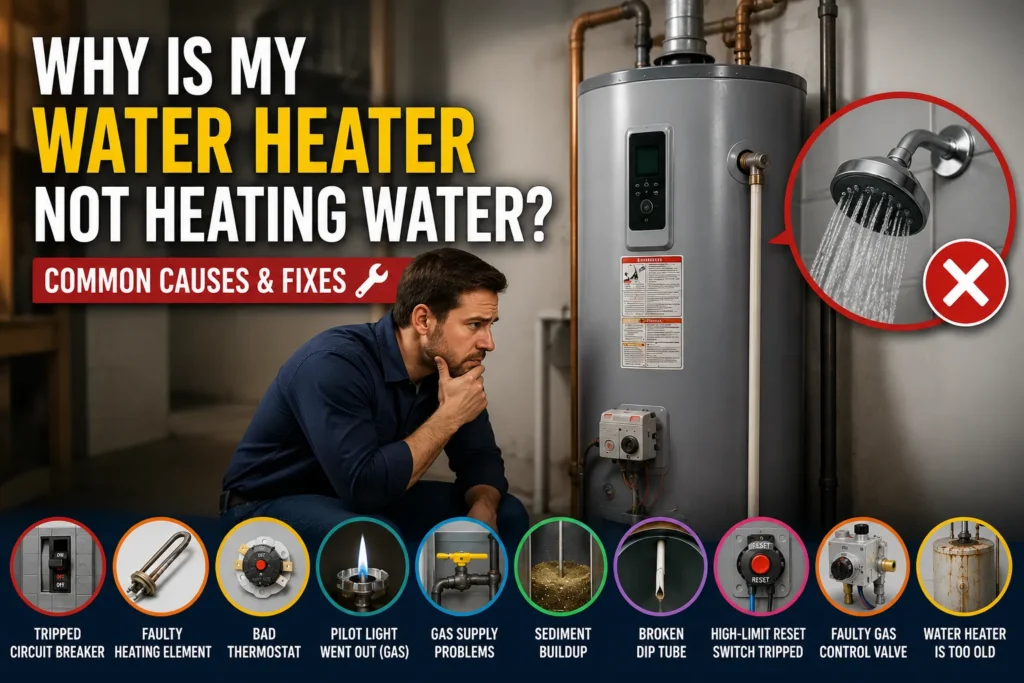
A water heater that isn’t heating water is usually caused by a tripped circuit breaker, a faulty heating element, thermostat failure, pilot light problems, gas supply issues, sediment buildup, or an aging unit. Determining whether you have an electric or gas water heater is the first step toward finding the right solution.
Few household problems are as frustrating as turning on the hot water tap and getting nothing but cold water. Whether you’re trying to take a shower, wash dishes, or do laundry, a water heater that stops producing hot water can quickly disrupt your day.
The good news is that many water heater problems have straightforward causes and can often be diagnosed before calling a professional. In this guide, you’ll learn the most common reasons a water heater is not heating water, how to troubleshoot each issue, which fixes you may be able to handle yourself, and when it’s time to contact a licensed plumber for water heater repair.
Signs Your Water Heater Is Not Working Properly
Water heaters rarely quit without warning. They give you a few weeks of hints first, and most homeowners miss them because the symptoms look minor.
Watch for these signs:
- No hot water at all. The most obvious symptom, and usually a power, gas, or heating element problem.
- Water only gets lukewarm. Often a failing heating element, a thermostat set too low, or a broken dip tube.
- Hot water runs out quickly. Sediment buildup is stealing tank capacity, or one of the two elements in an electric unit has burned out.
- Popping, rumbling, or crackling noises. Mineral deposits are baking against the bottom of the tank.
- Rust-colored water. The anode rod may be spent and the tank interior is corroding.
- Water pooling around the base. A leak from the tank body cannot be repaired. That unit needs replacing.
- A burning smell or scorched wiring near the panel. Shut the power off and call an electrician or plumber. Do not keep resetting the breaker.
- Error codes on the display. Tankless models and newer condensing units flag faults by code. Write the code down before you reset anything.
How to Diagnose the Problem Before Calling a Plumber
Five minutes of checking saves you a service call fee, or at minimum gives your plumber enough detail to arrive with the right part on the truck. Work through this decision tree in order.
Step 1: What type of water heater do you have?
Look at the top and side of the unit. A gas water heater has a flue pipe running out of the top and a gas line entering near the bottom control valve. An electric water heater has a thick electrical conduit entering the top and no flue. A tankless water heater is a wall-mounted box roughly the size of a carry-on suitcase.
Step 2: Is it the whole house or just one faucet?
Turn on the hot tap in two different rooms. If one faucet is cold and the rest are fine, the water heater is working. You have a fixture problem, a mixing valve fault, or a blocked supply line. If every hot tap in the house runs cold, the water heater itself is the issue.
Step 3: Did the power go out recently?
A power outage can trip the breaker, knock out the high-limit reset switch on an electric unit, or blow out the pilot light on an older gas model. This is the single most common cause of a water heater that stopped working overnight for no obvious reason.
Step 4: Is it cold or lukewarm?
Completely cold points to a total loss of power, gas, or a dead heating element. Lukewarm points to a partial failure, meaning one element still works, a thermostat drifted, or sediment is blocking heat transfer.
Step 5: How old is the unit?
Check the serial number sticker. Most manufacturers encode the build date in the first four digits. If the unit is past ten years, factor age into every decision that follows.
Most Common Reasons Your Water Heater Isn’t Heating Water
Here are the causes we see most often, roughly in order of frequency. Start at the top and work down, because the cheap fixes sit near the front of this list.
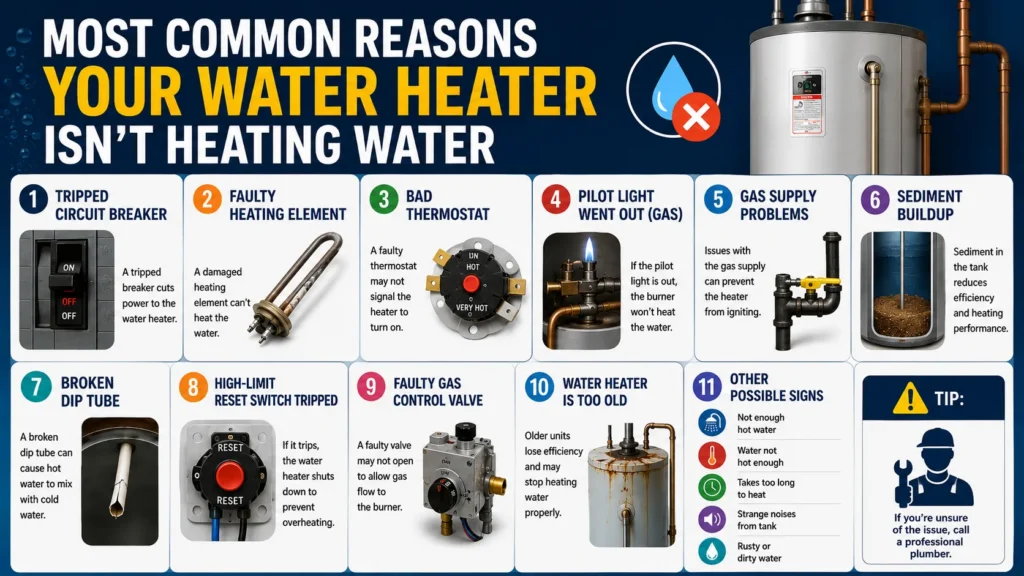
Tripped Circuit Breaker
Symptoms: No hot water at all on an electric water heater, nothing on the display, complete cold across the house.
How to check: Open your main electrical panel and find the double-pole breaker labeled for the water heater. A tripped breaker often sits between on and off rather than fully flipped, so it’s easy to skim past.
Fix: Push the breaker firmly to the off position first, then back to on. Wait 30 to 60 minutes and test a hot tap.
When to call a pro: If the breaker trips again within a day, stop resetting it. Repeated trips mean a shorted heating element, a wiring fault, or a failing breaker. That’s an electrical hazard, not an inconvenience.
Faulty Heating Element
Signs: Lukewarm water, or hot water that runs out far faster than it used to. Most residential electric water heaters use two elements. When the upper one fails you get no hot water. When the lower one fails you get a small amount of hot water followed by cold.
Testing: With power off at the breaker, remove the access panel and insulation, then check resistance across the element terminals with a multimeter. A working element reads roughly 10 to 30 ohms depending on wattage. An open reading means the element is burned out.
Replacement: Elements themselves are inexpensive, but the job involves draining the tank, unscrewing the old element with a socket wrench, and sealing the new one properly. Budget a couple of hours if you’ve done it before. If you haven’t worked inside an electrical panel, this is a good one to hand off.
Bad Thermostat
Symptoms: Water that’s too hot, not hot enough, or that swings between the two. Thermostats fail more quietly than elements, which is why people chase other causes first.
Temperature adjustment: Before replacing anything, pull the access panel and confirm the thermostat dial is set to 120°F. The U.S. Department of Energy recommends 120°F as the balance point between scald safety, bacterial control, and energy cost. Units get bumped down during service visits and nobody notices for months.
Replacement: Both upper and lower thermostats should be replaced as a pair. They’re cheap, and having one new and one aged part usually brings you back for a second repair inside a year.
Pilot Light Went Out (Gas)
How to relight: Turn the gas control knob to off and wait five full minutes for any gas to clear. Set the knob to pilot, press and hold it down, then ignite using the igniter button or a long lighter at the pilot assembly. Keep holding for 30 seconds after the flame catches, then release and turn the knob to on.
Safety: If you smell gas at any point, stop. Leave the house, then call your gas utility from outside. Never relight a pilot in a room that smells of gas.
If the pilot lights but won’t stay lit, the thermocouple has usually failed. That small copper sensor tells the gas valve the flame is present. When it degrades, the valve shuts off gas as a safety measure. It’s an inexpensive part and a routine repair for any plumber.
Gas Supply Problems
Closed valve: The gas shutoff valve on the supply line should run parallel to the pipe when open. A perpendicular handle means it’s closed. This gets bumped during other work near the unit more often than you’d expect.
Gas interruption: Utility work, an unpaid bill, or an automatic shutoff after a seismic event can cut supply. Check whether your gas range and furnace still work. If nothing gas-powered is running, the problem is upstream of your water heater.
Gas pressure: Low pressure produces a weak, lazy yellow flame and slow recovery times. Diagnosing pressure requires a manometer and belongs to a licensed technician.
Sediment Buildup
Symptoms: Reduced efficiency, longer recovery, hot water that runs out early, and higher energy bills for the same usage.
Popping sounds: That rumbling you hear is water trapped under a layer of hardened mineral deposits, boiling and forcing its way through. In hard water areas across [Service Area], this is the leading cause of premature tank failure.
Reduced efficiency: Sediment sits between the burner and the water in a gas unit, acting as insulation. The burner runs longer to hit the same temperature, which shortens the life of the tank.
Flushing: Connect a garden hose to the drain valve, run it to a floor drain or outside, shut off power or gas, close the cold water supply, then open the drain valve and let the tank empty. Open the supply briefly a few times to stir up remaining sediment. Plan on 30 to 45 minutes.
Broken Dip Tube
Signs: Lukewarm water throughout the house, worse when demand is high. The dip tube carries incoming cold water to the bottom of the tank. When it cracks or breaks near the top, cold water mixes straight into the hot layer and out to your taps.
Fix: The tube is replaceable and inexpensive, but reaching it means draining the tank and pulling the cold water inlet fitting. On units past ten years, most homeowners put that money toward replacement instead.
High-Limit Reset Switch Tripped
Why it trips: The ECO switch, marked by a red button between the upper thermostat and the access panel, cuts power when tank temperature climbs past roughly 180°F. It trips because a thermostat stuck closed, an element shorted, or the temperature setting was pushed too high.
Reset steps: Shut off the breaker. Remove the upper access panel and the insulation behind it. Press the red button firmly until you feel a click. Reinstall everything and restore power.
Here’s the part people skip. A tripped reset switch is a symptom, not the fault. If it trips a second time, something in the unit is overheating and needs diagnosing before you keep pressing that button.
Faulty Gas Control Valve
Symptoms: The pilot lights and holds, but the main burner never fires. Or the unit ignores the temperature dial entirely.
Repair: Gas control valves are sealed assemblies. They aren’t rebuilt in the field.
Replacement: The valve is one of the more expensive components on a gas water heater. Once you’re quoted for a control valve on a unit past eight years, compare that number against the cost of a new heater before approving the work.
Water Heater Is Too Old
Typical lifespan: Conventional tank water heaters generally last 8 to 12 years. Tankless units often run 20 years or more with descaling. Hard water shortens both figures.
Replacement indicators: Rust in the hot water, moisture at the base of the tank, a second major repair inside 18 months, or a jump in energy bills without a change in usage. When any two of these show up on a unit past ten years, replacement is the cheaper path.
Electric Water Heater Troubleshooting Guide
Work through this checklist in order. Cut power at the breaker before removing any panel.
- Power. Confirm the unit is receiving power at the disconnect or panel.
- Breaker. Reset the double-pole breaker once. Do not reset repeatedly.
- Reset button. Press the red high-limit reset switch behind the upper access panel.
- Heating elements. Test both elements for continuity with a multimeter. No continuity means a failed element.
- Thermostat. Verify the setting reads 120°F, then test the thermostat for continuity.
- Voltage. Confirm 240 volts at the element terminals with power restored. Reduced voltage points to a wiring or breaker fault.
If power, breaker, and reset all check out but both elements test fine, the problem is almost always the thermostat.
Gas Water Heater Troubleshooting Guide
- Pilot. Is it lit? If it won’t stay lit, move to the thermocouple.
- Thermocouple. A weak or dirty thermocouple shuts the gas valve as a safety response. Cleaning sometimes buys time. Replacement is the real fix.
- Burner. Look through the sight glass. A burner coated in soot or debris won’t transfer heat properly.
- Gas valve. If the pilot holds and the burner never fires, the control valve is the suspect.
- Ventilation. A blocked flue triggers the spill switch and shuts the unit down. This one matters for safety, not just hot water, because a blocked flue means combustion gases have nowhere to go.
- Flame color. A healthy flame burns steady blue. Yellow or orange flames signal incomplete combustion and need a technician the same day.
Tankless Water Heater Not Heating?
Tankless water heaters fail differently than tank models, and the fixes are different too.
Mineral buildup. Scale coats the heat exchanger and blocks heat transfer. Descaling with a vinegar or manufacturer-approved solution restores performance. Most brands specify annual descaling, more often in hard water.
Error codes. The display gives you the diagnosis. Look the code up in the manual before touching anything, because codes for ignition failure, flow sensor faults, and venting problems all present as no hot water.
Water flow. Tankless units need minimum flow to activate, typically around 0.5 gallons per minute. A restricted aerator or a partially closed valve can drop you below that threshold, and the unit simply won’t fire.
Ignition. Failed ignition usually means gas supply, a dirty igniter, or insufficient gas volume for the unit’s demand. Undersized gas lines are a frequent cause after a tank to tankless conversion.
Filters. The inlet screen filter clogs with debris. Shut off the water, remove and rinse it. This takes five minutes and solves more complaints than most homeowners expect.
Maintenance. Annual descaling plus filter cleaning is the difference between a tankless unit lasting 12 years and lasting 20.
DIY Fixes You Can Try First
Before booking a service call, try these in order:
- Reset the high-limit switch. One press, behind the upper access panel on electric units.
- Check the thermostat setting. Raise it toward 120°F if it drifted low.
- Flush the tank. Clears sediment and often restores lost capacity.
- Check the breaker. Full off, then full on. Once only.
- Relight the pilot. Follow the instructions printed on the unit label, and stop immediately if you smell gas.
- Inspect the valves. Confirm the cold water supply valve and gas shutoff valve are fully open.
When You Should Call a Professional Plumber
Some symptoms are not troubleshooting opportunities. Call right away for any of these:
- A gas smell. Leave the building first, then call from outside.
- Water leaking from the tank body. A leaking tank is not repairable and can flood a finished space fast.
- Any electrical issue. Scorch marks, melted insulation, or a burning smell near the panel.
- Repeated breaker trips. More than one trip means a short somewhere in the circuit or the element.
- Visible corrosion. Rust at fittings, the base, or in the hot water itself.
- Pressure valve discharge. If the temperature and pressure relief valve is releasing water, the tank is over-pressurized. That’s a safety issue, not a drip to ignore.
- Tank damage. Bulging, deformation, or seam separation.
Repair vs Replace: Which Is Better?
Age drives this decision more than the specific fault does.
Water Heater Age | Recommendation |
Under 6 years | Repair |
6 to 10 years | Depends on repair cost |
10 to 12+ years | Usually replace |
Leaking tank | Replace |
A practical rule: if the repair quote exceeds half the cost of a new unit and the heater is past eight years, replace it. You’ll spend a little more today and skip the second repair call that tends to follow within a year or two.
Also weigh efficiency. A heater installed twelve years ago costs meaningfully more to run than a current model at the same output, so part of the replacement cost comes back through lower monthly bills. Current pricing in [City] runs [local price range] for a standard tank replacement and [local price range] for tankless, though sizing, venting, and code upgrades all shift the number.
How to Prevent Future Water Heater Problems
Most emergency water heater repair calls trace back to maintenance that never happened. Preventive care is cheap by comparison.
- Flush the tank annually. Sediment removal is the single highest-value maintenance task, especially in hard water areas.
- Keep the temperature at 120°F. Safer, more efficient, and easier on the tank.
- Inspect the anode rod every two to three years. This sacrificial rod corrodes so the tank doesn’t. Replacing a worn rod is far cheaper than replacing a rusted tank.
- Consider a water softener. If you have hard water, softening protects the water heater, the plumbing system, and your fixtures at once.
- Book annual maintenance. A technician checks the T&P valve, burner or elements, connections, venting, and expansion tank in one visit.
- Test the T&P valve yourself. Lift the lever briefly once a year and confirm water discharges and stops cleanly.
Conclusion
Most of the time, a water heater not heating water comes down to a handful of causes. Power and breaker problems, a burned out heating element, a drifting thermostat, a pilot light that went out, gas supply interruptions, or sediment that has been building for years.
Start with the free checks. Confirm your heater type, test whether the problem is house-wide, reset the breaker once, press the high-limit switch, and verify the thermostat setting. Flush the tank if it hasn’t been done in the past year. Those steps solve a real share of no hot water calls without anyone coming out.
Then know where to stop. Gas odors, leaking tanks, scorched wiring, repeated breaker trips, and a discharging pressure valve are not DIY territory. Neither is a unit past ten years with a major component failure, where repair money is usually better spent on replacement.