
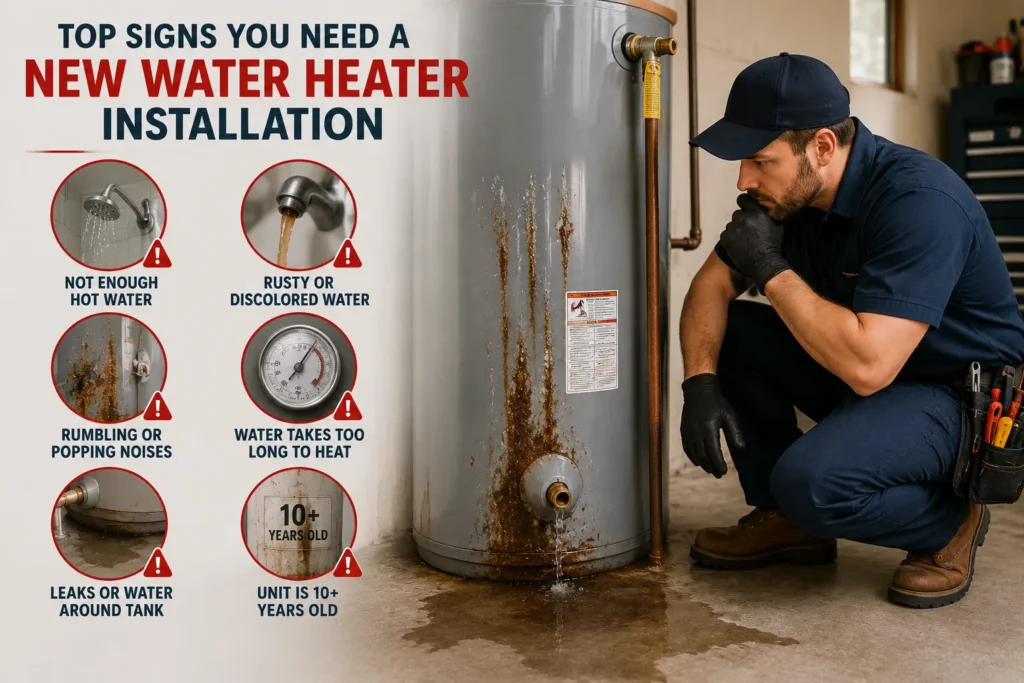
The shower went cold halfway through. Not slowly. Without warning, on a Tuesday morning before work. Or maybe it was different for you. A small puddle near the base of the water heater one morning, easy to miss. You mopped it up and came back two days later. Still damp.
Both of those moments share something. The water heater had already been signaling long before either one happened. Signs of a dying water heater rarely announce themselves loudly. They show up in the water bill, in sounds you start tuning out, in water that runs slightly off-color. By the time most people look for answers, the problem has been building for months. Corbin’s Air, Water & Power Solutions has been diagnosing water heaters across Tennessee Valley homes since 1935.
The Short Answer: What These Signs Actually Mean
You need a new water heater if your unit is over 10 years old and showing any of these problems: rust-colored water from the hot tap, rumbling or popping sounds from the tank, hot water running out noticeably faster than before, water pooling at the base, energy bills that climbed without a change in usage, or water temperature that fluctuates during a single shower. Any one of these in a unit approaching 10 years warrants a call. Two of them together almost always means replacement makes more financial sense than continuing to repair.
How Long Should a Water Heater Last? Start Here
A standard tank water heater carries a rated service life of 8 to 12 years. Tankless units last considerably longer, often 15 to 20 years, because they have no standing tank to corrode and fewer components under constant water pressure. These figures assume average water conditions and consistent maintenance. Neither applies cleanly to Tennessee Valley homes.
North Alabama’s water runs hard. Guntersville, Albertville, and the surrounding Marshall County area draw water with higher mineral content than the national average. Those minerals settle at the bottom of a tank as sediment and speed up the depletion of the anode rod, the sacrificial metal component that attracts corrosion so the tank wall doesn’t have to. In practice, Corbin’s sees tank units in this region reach the end of their useful life closer to 8 or 9 years, not 12.
If you don’t know when your unit was installed, the serial number on the manufacturer’s label tells you. On most major brands, the first two or four characters encode the manufacture date. Photograph the label and call us. We read these daily and can tell you the age in under a minute.
Replacing a 50-gallon electric unit in Huntsville runs between $1,300 and $1,700 installed. Knowing that number now means you’re making a planned decision, not an emergency one. For Sand Mountain homeowners dealing with aging plumbing alongside an older water heater, our water heater replacement and pipe repair guide for Albertville covers what that combination typically looks like in practice.
7 Signs Your Water Heater Is Telling You Something
Most of these signs show up quietly. A water temperature that drops a little faster than it used to. A bill that climbed two months in a row for no obvious reason. By the time any of them feel serious, the unit has usually been running degraded for a while.
Some point clearly toward a single repair. Others point toward replacement, especially in a unit already pushing 8 or 9 years. Where two or more signs appear together, replacement is the better option, regardless of the unit’s age.
1. It’s Over 10 Years Old Even If It Seems Fine
A 10-year-old tank water heater that seems fine is not necessarily fine. The anode rod inside has likely been depleted for a year or two already. The dip tube, a plastic pipe that pushes cold water to the bottom so hot water rises cleanly to the top, degrades around the 8-to-10-year mark and cracks without producing any visible symptom. Heating elements lose efficiency gradually. The unit heats water, the shower stays warm, and nothing seems wrong until something does.
Tankless units give you more time. A well-maintained Rinnai system can run 15 to 20 years before component failure becomes a real concern. A standard tank does not carry that margin. The serial number on the label near the top of the unit tells you when it was made. Photograph it and call us. We’ll tell you exactly how old it is and whether it’s still worth putting repair money into.
2. The Hot Water Looks Rusty or Has a Metallic Taste
Run the hot tap for 30 seconds. If the water comes out brown or carries a faint metallic smell, two things cause this and only one means you need a new water heater
Every tank water heater has an anode rod screwed into the top. It’s a long metal rod, usually magnesium or aluminum, and its job is to corrode so the steel tank wall doesn’t have to. When the rod runs out of material, the corrosion shifts to the tank itself. Rusty water is the first signal that the rod has depleted, or that the tank has already started corroding from the inside.
Here’s how to tell which one you’re dealing with. A plumber replaces the anode rod and you run the hot tap a few days later. If the rust clears, the rod was the problem. If the water stays brown, the tank wall is corroding. Nobody repairs a corroding tank.
We’ve pulled anode rods out of homes across Marshall County that had nothing left to give. The homeowners had been running rust-tinged water for months and assumed it was a pipe issue. In a unit over 8 years old with rusty water, it’s the rod first. The tank usually follows within a year or two.
Rusty water in a unit under 8 years old: replace the anode rod first. If the rust stays after a rod replacement, or the unit is already past 10 years, a new installation is the practical next step.
3. Rumbling, Popping, or Banging Sounds
That noise coming from the utility closet is sediment. Minerals from your water supply settle at the bottom of the tank over years, and the heating element or burner fires through that layer every cycle. The rumbling you hear is the burner forcing heat through it. The popping is steam pockets escaping through the crust as the water below it heats up.
A flush removes loose sediment and stops the noise in a unit under 6 years old with no prior maintenance. Once the layer hardens and packs down, flushing moves less of it. The noise returns faster after each flush, the unit runs longer to heat the same amount of water, and the energy bill reflects it.
In a Guntersville home with hard water, sediment builds faster than in most parts of the country. We’ve opened tanks that looked 12 years old from the sediment layer alone, only to find a 7-year manufacture date on the label. Water quality in Marshall County accelerates this more than most homeowners realize.
4. Hot Water Runs Out Significantly Faster Than It Used To
A 40-gallon tank holds 40 gallons of hot water. When sediment packs the bottom, it takes up physical space in the tank and the effective hot water capacity drops. A household that used to get three full showers before the water turned cold now gets two. Nothing broke. The tank just holds less usable hot water than it did when it was new.
A failed lower heating element produces the same symptom in an electric unit. The element at the bottom of the tank stops working and the unit heats only the water in the upper portion of the tank. You get hot water for a short window and then it runs cold. Not gradually. It goes cold within a single shower.
Gradual capacity loss over months points to sediment buildup. Sudden capacity loss that appeared recently points to a failed element or thermostat. A plumber tests the elements in under 10 minutes and knows immediately which one failed.
In a unit under 8 years old, replacing a failed element runs well under $200 parts and labor and buys years of service. In a unit past 9 or 10 years, putting that repair cost into a unit already near the end of its life is the call worth questioning.
5. Water Pooling Around the Base of the Tank
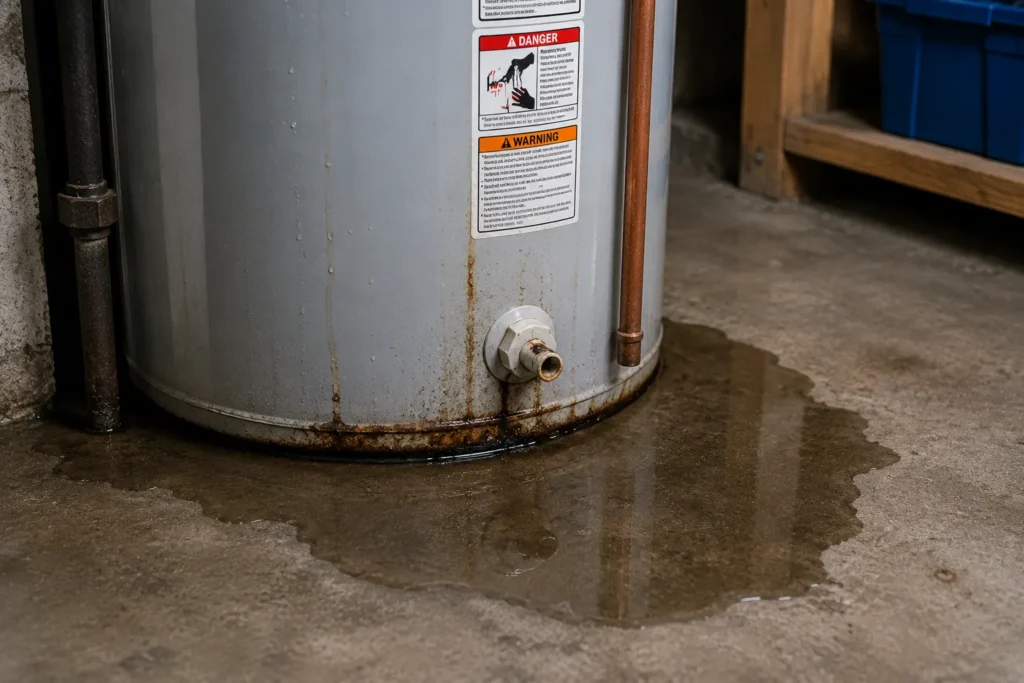
Water on the floor near your water heater is not a wait-and-see situation. The source matters. Water dripping from the pressure relief valve discharge tube, a copper or plastic tube that runs down the side of the tank and terminates near the floor, points to excess pressure inside the tank or a valve that no longer reseats properly after opening. A dripping inlet or outlet connection at the top of the unit points to a loose fitting or failed seal. Both of those are repairs.
Water appearing directly at the base of the tank, or moisture along the seam where the tank body meets the base, tells a different story. Internal corrosion has eaten through the tank wall. Once the steel lining breaches, no repair fixes it. The tank gets worse from that point forward, not better.
We pulled a 9-year-old unit in Huntsville last year where the homeowner noticed a small damp spot and waited three weeks to call. By the time we got there, the bottom of the unit had failed and 40 gallons of water had reached the subfloor. The repair bill for the floor and drywall ran four times the cost of a planned replacement.
Do this right now if you see water at the base. Find the cold water supply valve at the top of the tank, the one feeding cold water in, and shut it off. For a gas unit, turn the thermostat dial to Pilot. For electric, flip the breaker. Then call us at (256) 530-7477. Our technicians are available 24 hours a day throughout the Tennessee Valley.
6. Energy Bills Climbed Without a Usage Change
Pull up the last four months of utility bills and compare them to the same four months a year ago. If the numbers went up and nothing else changed like same household size, same appliances, same routine. The water heater is worth looking at.
Sediment at the bottom of the tank sits between the heating element and the water. The element fires longer to push the same amount of heat through that insulating layer. The unit runs more cycles per day. The meter keeps moving. You pay more for the same result.
A failing thermostat produces the same bill through a different failure. The thermostat no longer reads the water temperature accurately. The unit heats past the set point without knowing it, running when it shouldn’t. On a gas unit, the burner fires continuously in a way that shows up on the gas bill before anything else.
This sign alone doesn’t force a replacement decision. In a unit under 8 years old, flushing the tank or replacing the thermostat solves it. In a unit over 9 years old that’s also running out of hot water faster or making noise, the rising bill is one more data point in a picture that points toward replacement.
7. Inconsistent Water Temperature or Sudden Cold Patches
A water temperature that drops mid-shower without anyone running another tap has a specific failure behind it, not a vague “ageing unit” problem. The dip tube is a long plastic pipe that runs from the cold water inlet at the top of the tank down to the bottom. Its job is to push incoming cold water to the floor of the tank, where the heating element warms it, so hot water rising to the top stays undiluted. When the dip tube cracks or breaks, cold water dumps into the upper section of the tank and mixes with the outgoing hot water. You get a shower that starts warm and turns lukewarm without warning, even with a full tank.
A cracked dip tube in a unit under 8 years old is a repair. The part costs very little, and the swap is straightforward for a licensed plumber. Thermostat drift produces a different pattern. The temperature doesn’t drop suddenly mid-shower. Instead, the water gradually runs cooler than the set point over weeks, or fluctuates between too hot and not hot enough without any consistent pattern. A dual-element electric unit with a failed upper thermostat heats the top half of the tank only. The first few gallons run hot. Everything after runs lukewarm.
In a unit over 10 years old with thermostat drift and at least one other sign present, the cost of replacing two or more internal components approaches the cost of a new unit. At that point, putting money into the old one is the wrong call.
Sign-by-Sign Quick Reference
Sign | Most Likely Cause | Verdict |
Unit is over 10 years old | Internal component wear across the board | Assess now, don’t wait for a failure |
Rusty or brown hot water | Depleted anode rod or tank corrosion | Repair (rod) or Replace (tank). One service call tells you which |
Rumbling, popping, or banging | Hardened sediment buildup | Flush if under 6 years old; Replace if over 8 with recurring noise |
Hot water runs out faster | Sediment reducing capacity or failed lower heating element | Repair in younger unit; Assess full picture over 9 years |
Water pooling at base | Fitting/valve leak or tank wall breach | Repair at fittings; Replace if water sits at tank body or seam |
Rising energy bills, no usage change | Sediment insulating element or thermostat drift | Flush or thermostat repair under 8 years; Replace if other signs present |
Temperature inconsistency mid-shower | Cracked dip tube or thermostat failure | Repair in unit under 8 years; Replace if over 10 with other signs |
What About Tankless Water Heaters: Are the Signs Different?
A tankless unit fails differently than a tank. No standing water means no rust-colored output, no sediment rumble, no puddle at the base. The signs are quieter and easier to misread as something else.
Reduced flow at the tap is the clearest one. Scale from mineral buildup accumulates inside the heat exchanger and narrows the water pathway over years. The unit fires normally, the ignition works, but the output pressure drops noticeably. A lot of homeowners chalk this up to a pressure problem elsewhere in the house. In North Alabama’s hard water conditions, scale in a tankless heat exchanger is the first thing to check.
Error codes that keep returning after a reset are the second signal. Every tankless unit has a diagnostic system that logs fault codes. A code that clears and comes back within days points to a component failing under load, not a sensor glitch or a one-time pressure drop. Rinnai units log these codes with enough detail that a trained technician reads the history and knows what failed before opening anything.
A whistling or hissing sound when the unit fires points to the same scale problem as reduced flow. The heat exchanger strains to push water through a restricted passage. The noise is the restriction.
Tankless units hold up well past the 10-year mark that signals replacement territory for a tank. A well-serviced Rinnai running in normal conditions goes 15 to 20 years without major component failure. Annual descaling in a hard water area like the Tennessee Valley extends that. A unit that hasn’t had a descaling in three or more years and starts showing reduced flow or recurring error codes needs service, not replacement in most cases.
Tank Water Heater Signs | Tankless Water Heater Signs |
Rusty or brown hot water | Reduced flow at the tap |
Rumbling or popping sounds | Whistling or hissing when firing |
Water pooling at the base | Error codes that return after reset |
Hot water runs out faster | Output that drops under high demand |
Rising energy bills | Longer ignition delay before hot water arrives |
When Does Repair Actually Make More Sense Than Replacement?
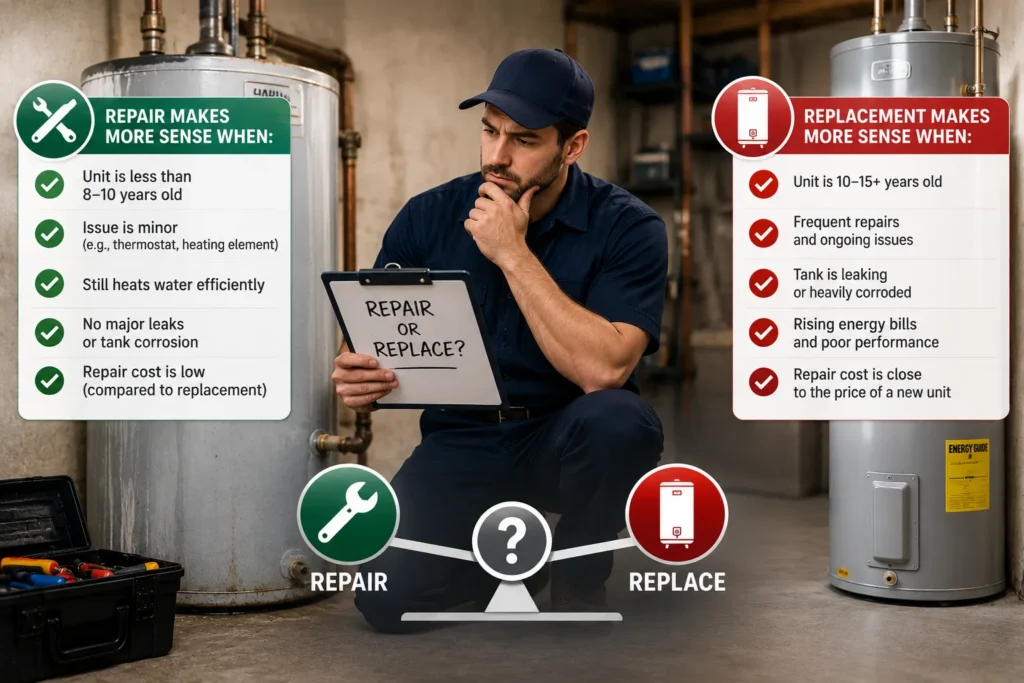
Replacement is not always the right answer. A technician who tells every caller to replace their water heater is not giving honest advice. Corbin’s gives honest advice, and the repair recommendation comes up regularly.
A unit under 8 years old with a single component failure is a repair. Heating elements, thermostats, anode rods, dip tubes, thermocouples on gas units, pressure relief valves. Every one of those parts can be replaced within an hour, and costs a fraction of a new installation. A burned-out lower heating element at year 6 is not a water heater problem. It’s a $200 repair.
The calculation changes past the 8-year mark and changes decisively past 10. At that point, the anode rod has worn through. The internal lining has taken years of corrosion exposure. Replacing one component on a unit with four components approaching failure means a service call again in 6 months. The repair cost stacks against a $1,300 to $1,700 replacement, and the math stops working in favor of repair. Tank corrosion at any age ends the repair conversation. A compromised tank wall doesn’t get a patch. It gets a new unit.
Under 8 years old, single component failure: repair. Over 10 years old with any sign from the list above: assess whether the repair cost exceeds 30 to 40% of a new installation. If it does, replace. Tank body leaking at any age: replace, no exceptions. Two or more signs present regardless of age: the repair math rarely holds up. Flexible financing makes a planned replacement easier to manage than an emergency one. Ask about current options when you call.
Ready to Find Out What Your Water Heater Actually Needs?
That cold shower or the puddle you spotted this morning is worth a phone call before it turns into a flooded utility room at midnight. The signs on this list don’t always mean you need a new water heater. Sometimes a $200 repair buys you four more years. Sometimes the unit is three weeks from a full tank failure and every month you wait adds water damage to the replacement cost. The difference between those two situations comes down to what’s actually failing inside the unit.
Corbin’s has been making that call honestly in Tennessee Valley homes since 1935. Licensed under Alabama Plumbing License MPG-0847, 139 five-star Google reviews, and a straightforward policy: we tell you what we’d do if it were our own unit. If repair is the right answer, we say repair. If the unit needs to go, we tell you that before any work starts and give you a written quote that doesn’t change at the end of the job.
We install Rinnai tankless systems alongside standard tank replacements. Financing is available if you’re looking at a full replacement and want to spread the cost. For homeowners thinking about the rest of their plumbing alongside the water heater, our whole-home plumbing assessment for New Hope homeowners covers every component at once. For full-service plumbing throughout the Tennessee Valley, we’re the team that’s been doing this work here longer than most. Call (256) 530-7477 or book your water heater assessment online.
FAQ’s
What are the signs that you need a new hot water heater?
The seven main ones are: a unit over 10 years old, rusty hot water, rumbling or popping sounds, hot water running out faster than it used to, water pooling at the base, rising energy bills without a usage change, and temperature inconsistency mid-shower. Two or more together almost always means replacement makes more sense than repair.
How do I find out how old my water heater is?
The serial number on the label near the top of the unit tells you. On most major brands, the first two or four characters encode the manufacture year. Photograph the label and call us at (256) 530-7477. We’ll tell you the age in under a minute and whether it changes your decision.
Should I repair or replace my water heater?
Under 8 years old with a single failing component, repair wins. Over 10 years old with any sign of wear, or if the repair cost runs above 30 to 40 percent of a new installation, replacement is the better investment. A corroding tank at any age needs a new unit, not a repair. We’ll tell you which side of that line you’re on before any work starts.
Does hard water shorten how long a water heater lasts?
It does, and North Alabama’s water runs hard. Mineral deposits accelerate sediment buildup and wear through the anode rod faster than the 12-year national lifespan average suggests. In the Tennessee Valley, plan on 8 to 9 years for a tank unit rather than 12. Annual flushing slows that down considerably.
What should I do if my water heater is leaking?
Shut the cold water supply valve at the top of the tank right now. Gas unit: turn the thermostat to the pilot setting. Electric unit: flip the breaker. Then call us at (256) 530-7477. A leak at a fitting is a repair. Water at the tank body or base seam means the tank is failing and waiting makes it worse.
Why is my hot water running out faster than it used to?
Sediment at the bottom of the tank reduces usable capacity. A 50-gallon tank with three inches of hardened sediment holds closer to 42 gallons of usable hot water. In a younger unit, a professional flush restores it. In a unit over 9 years old, the capacity loss doesn’t fully come back after flushing. At that point, a new installation makes more sense.
What should I know before replacing a water heater?
Know your fuel type (gas or electric), your current tank size, and whether the space fits a tankless upgrade. Check whether the existing venting, wiring, or gas line needs work alongside the installation. Corbin’s covers all of that during the assessment visit and gives you a written quote before any work starts.
Is rusty hot water always a sign I need a new water heater?
Not always. Rusty hot water first points to a depleted anode rod, which is a repair. A plumber replaces the rod and runs the tap a few days later. If the rust clears, the rod was the issue. If the water stays brown, the tank is corroding from the inside and replacement is the next step. One visit tells you which one you have.
The seven main ones are: a unit over 10 years old, rusty hot water, rumbling or popping sounds, hot water running out faster than it used to, water pooling at the base, rising energy bills without a usage change, and temperature inconsistency mid-shower. Two or more together almost always means replacement makes more sense than repair.
The serial number on the label near the top of the unit tells you. On most major brands, the first two or four characters encode the manufacture year. Photograph the label and call us at (256) 530-7477. We’ll tell you the age in under a minute and whether it changes your decision.
Under 8 years old with a single failing component, repair wins. Over 10 years old with any sign of wear, or if the repair cost runs above 30 to 40 percent of a new installation, replacement is the better investment. A corroding tank at any age needs a new unit, not a repair. We’ll tell you which side of that line you’re on before any work starts.
It does, and North Alabama’s water runs hard. Mineral deposits accelerate sediment buildup and wear through the anode rod faster than the 12-year national lifespan average suggests. In the Tennessee Valley, plan on 8 to 9 years for a tank unit rather than 12. Annual flushing slows that down considerably.
Shut the cold water supply valve at the top of the tank right now. Gas unit: turn the thermostat to the pilot setting. Electric unit: flip the breaker. Then call us at (256) 530-7477. A leak at a fitting is a repair. Water at the tank body or base seam means the tank is failing and waiting makes it worse.
Sediment at the bottom of the tank reduces usable capacity. A 50-gallon tank with three inches of hardened sediment holds closer to 42 gallons of usable hot water. In a younger unit, a professional flush restores it. In a unit over 9 years old, the capacity loss doesn’t fully come back after flushing. At that point, a new installation makes more sense.
Know your fuel type (gas or electric), your current tank size, and whether the space fits a tankless upgrade. Check whether the existing venting, wiring, or gas line needs work alongside the installation. Corbin’s covers all of that during the assessment visit and gives you a written quote before any work starts.
Not always. Rusty hot water first points to a depleted anode rod, which is a repair. A plumber replaces the rod and runs the tap a few days later. If the rust clears, the rod was the issue. If the water stays brown, the tank is corroding from the inside and replacement is the next step. One visit tells you which one you have.